
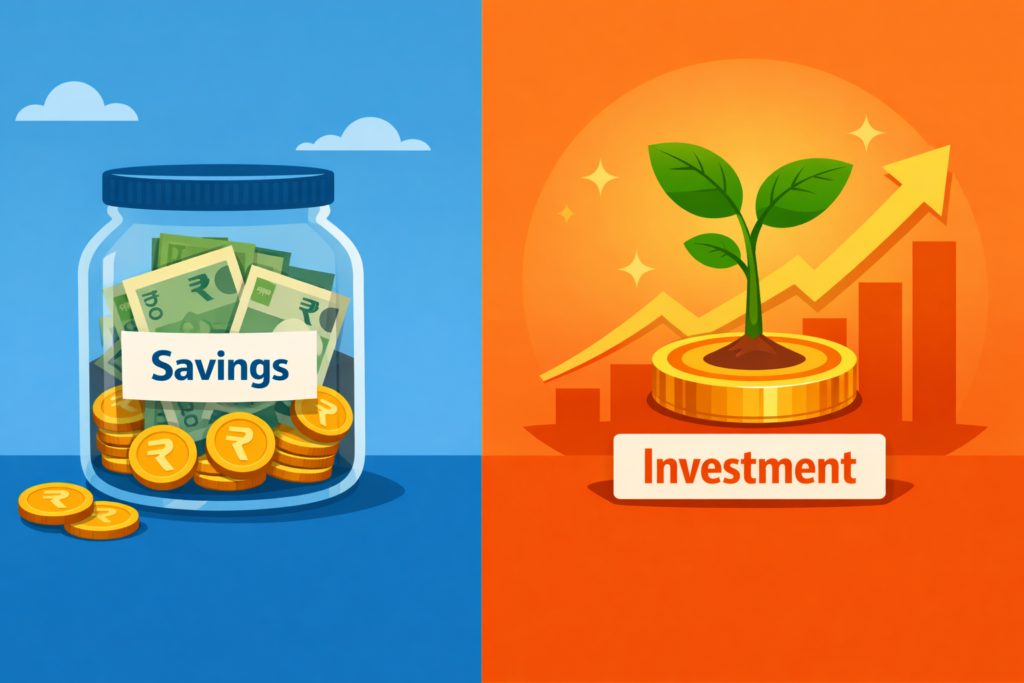
The One Financial Confusion That is Quietly Keeping Millions of Indians Stuck
Let’s start with a very simple question.
If someone asked you right now — “Are you saving money or investing money?” — would you know the exact difference between the two?
Most people pause. Some say “same thing, right?” Others give a vague answer. And that pause, that confusion, is costing them years of financial progress.
Saving and investing are not the same thing. They never were. Understanding the difference between the two is not just useful financial knowledge — it is one of the most important money lessons you will ever learn. And the earlier you learn it, the better your financial life will be.
Let’s break it down completely — in the simplest words possible.
What is Saving?
According to the Reserve Bank of India, savings deposits in Indian banks currently earn between 2.5% to 4% interest per year.st per year.
Saving means setting aside money safely so that it is available when you need it — without any significant risk of losing it.
Think of saving as building a financial cushion. A safety net. Money that sits in a secure place, grows very slowly, and is always accessible.
Examples of Saving:
- Keeping money in a savings bank account
- Opening a Fixed Deposit (FD)
- Starting a Recurring Deposit (RD)
- Storing cash at home (though not recommended)
The goal of saving is protection and accessibility — not growth.
What is Investing?
Investing means putting your money to work so that it grows significantly over time — with the understanding that there is some level of risk involved.
When you invest, your money is not just sitting somewhere safe. It is actively working — buying assets, generating returns, compounding over years. The growth potential is much higher than savings, but so is the risk.
Examples of Investing:
- Buying mutual funds or starting a SIP
- Investing in the stock market
- Buying gold or real estate
- Investing in government schemes like PPF or NPS
The goal of investing is wealth creation — building a significantly larger amount of money over the long term.
The Key Differences — Point by Point
Here is where it all becomes crystal clear. Let’s look at every major difference between saving and investing.
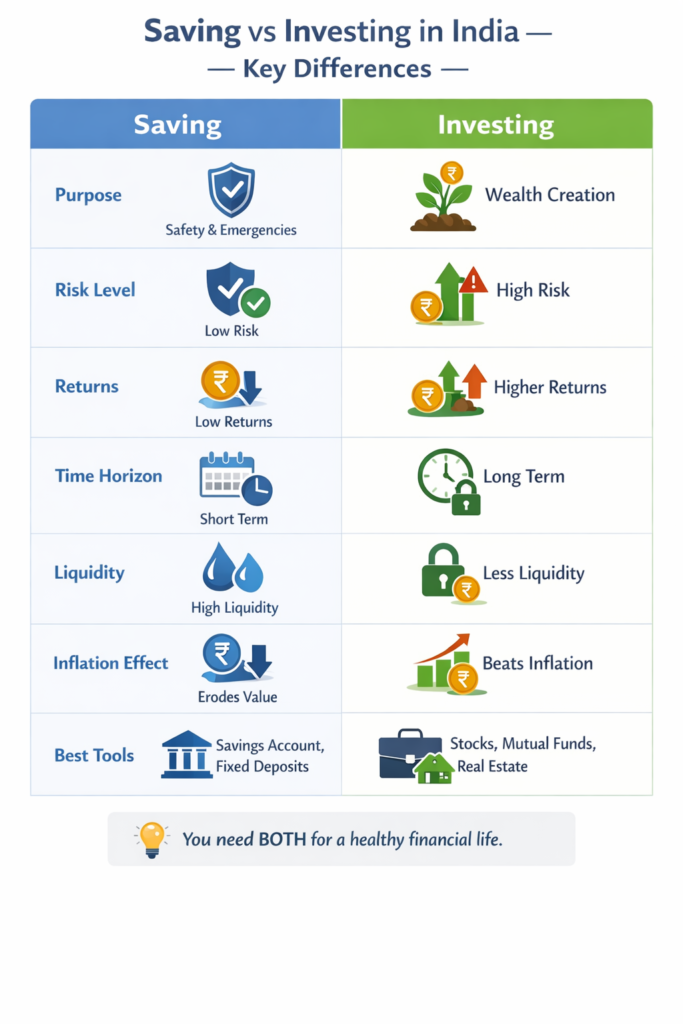
1. Purpose
Saving — The purpose is to keep your money safe and available for short-term needs or emergencies. You save for things you might need soon — a medical emergency, a sudden repair, a planned expense in the next few months.
Investing — The purpose is to grow your wealth over the long term. You invest for things that are years away — retirement, your child’s education, buying a house, building long-term financial independence.
2. Risk Level
Saving — The risk is extremely low. Your principal amount (the money you put in) is almost always safe. A savings account, FD, or RD will not lose your original money.
Investing — The risk is higher. The value of investments can go up and it can also go down. Stock prices fall. Mutual funds have bad years. Real estate markets go through cycles. The risk varies depending on where you invest, but it is always present to some degree.
3. Returns (How Much Your Money Grows)
Saving — Returns are low and predictable. A savings account gives you roughly 2.5% to 4% per year. An FD might give 6% to 7.5%. These are fixed, guaranteed numbers — no surprises, no excitement, and unfortunately, no real wealth creation either.
Investing — Returns are higher but variable. A well-chosen mutual fund SIP has historically delivered 10% to 15% returns per year over the long term. Stock market investments can give even more — or less. The uncertainty is part of the deal, and it is also the reason your money can grow significantly.
4. Time Horizon (How Long You Keep the Money There)
Saving — Savings are meant for the short term. You might need this money in a few weeks, months, or a year or two. The idea is to keep it easily accessible.
Investing — Investments are meant for the long term — ideally 5, 10, 15, or even 20+ years. The longer you stay invested, the more the power of compounding works in your favour. Pulling out investments too early often results in losses or missed growth.
5. Liquidity (How Easily Can You Access the Money?)
Saving — Highly liquid. Your savings account money is available 24/7. Even an FD can be broken (with a small penalty) whenever needed. In an emergency, savings are your immediate go-to.
Investing — Less liquid. Selling stocks or redeeming mutual funds takes time — usually 1 to 3 business days. Real estate can take months or even years to sell. Investments are not designed for quick access.
6. Effect of Inflation
Saving — This is the hidden danger of saving too much in low-return accounts. If inflation is at 6% and your savings account gives you 3%, your money is actually losing purchasing power every year. You have more rupees, but those rupees buy less.
Investing — Good investments beat inflation over time. That is one of their most important jobs. A 12% return on a mutual fund when inflation is 6% means your money is genuinely growing in real terms — you can actually buy more with it in the future.
7. Mental Relationship With the Money
Saving — When you save, you are thinking about today and the near future. It is a defensive mindset — and a very important one.
Investing — When you invest, you are thinking about the distant future. It is an offensive mindset — growth-focused, patient, and forward-looking.
Both mindsets are necessary. A complete financial life needs both.
So What is the Real Mistake People Make?
Most Indians fall into one of two traps:
Trap 1 — Only Saving, Never Investing. They keep everything in FDs and savings accounts, feel “safe,” and wonder 20 years later why they never built any real wealth. Meanwhile, inflation quietly ate into their money year after year.
Trap 2 — Only Investing, Never Saving. They put every rupee into stocks or mutual funds, feel financially smart, and then one unexpected emergency forces them to break their investments at a loss — wiping out months or years of progress.
The real answer is both, in balance.
A Simple Formula to Start With
A very practical starting point that works well for most people:
- Keep 3 to 6 months of monthly expenses in savings — for emergencies and short-term needs.
- Invest at least 20% of your monthly income for long-term goals — through SIPs, PPF, or any instrument that suits your risk level.
- Increase your investment percentage every time your income increases.
You do not need to be a finance expert to do this. You just need to start.
The Bottom Line
Saving keeps you safe today. Investing makes you free tomorrow. You need both — not one or the other.
The moment you understand this difference clearly, you stop seeing money management as confusing or intimidating. It becomes a simple, empowering act of taking control of your own future.
Start saving for safety. Start investing for growth. And start today — because the only thing more powerful than money is time, and that is something you can never get back.
For a deeper understanding of financial planning, the Securities and Exchange Board of India (SEBI) offers free investor education resources for every Indian.
Frequently Asked Questions (FAQs)
Q1. What is the main difference between saving and investing?
Saving means keeping your money in a safe place with low risk and low returns — like a bank account or FD. Investing means putting your money into assets like mutual funds, stocks, or real estate where it can grow significantly over time, but with some level of risk involved. In simple terms — saving protects your money, investing grows your money.
Q2. Which is better — saving or investing?
Neither one is “better” on its own. Both serve different purposes. Saving is essential for emergencies and short-term needs. Investing is essential for long-term wealth creation. A healthy financial life needs a smart balance of both. Most financial experts suggest keeping 3 to 6 months of expenses in savings and investing at least 20% of your monthly income.
Q3. Can a savings account beat inflation in India?
No. A regular savings account in India gives around 2.5% to 4% interest per year, while inflation typically runs at 5% to 6%. This means your money is actually losing purchasing power over time when kept only in a savings account. To truly beat inflation, you need to invest in instruments that give higher returns, such as mutual funds, PPF, or equities.
Q4. What is the safest investment option for beginners in India?
For absolute beginners, some of the safest starting points are Public Provident Fund (PPF), which is government-backed and tax-free, and SIP in large-cap mutual funds, which offer relatively stable growth over the long term. These are low-pressure ways to start investing without needing deep financial knowledge.
Q5. How much money should I save before I start investing?
A practical rule is to first build an emergency fund equal to at least 3 months of your monthly expenses. Once that cushion is in place, you can start investing — even with as little as ₹500 per month through a SIP. You do not need a large amount to start. Starting early matters far more than starting with a big amount.
Q6. Is FD (Fixed Deposit) saving or investing?
An FD sits somewhere in between, but it is closer to saving than investing. It offers guaranteed, fixed returns with virtually no risk, which makes it a savings instrument. However, since FD returns are slightly higher than a regular savings account, many people use it as a conservative short-term option. For long-term wealth creation, FD alone is not enough.
Q7. At what age should I start investing in India?
The honest answer is — as early as possible. Even if you are 18 or 20 years old and earning a small amount, starting a SIP of ₹500 per month creates a powerful compounding habit. The earlier you start, the less money you actually need to invest to reach a large corpus. Time is the most valuable ingredient in investing, and once it is gone, it cannot be recovered.
Liked this? Share it with someone who needs to read this today.
For more honest, simple money guides, Follow MistakeIndia.com