

How to Beat Lifestyle Inflation
Knowing about lifestyle inflation is good. But taking action is what matters.
This guide gives you 5 simple steps. Follow them and your money will finally start working for you.
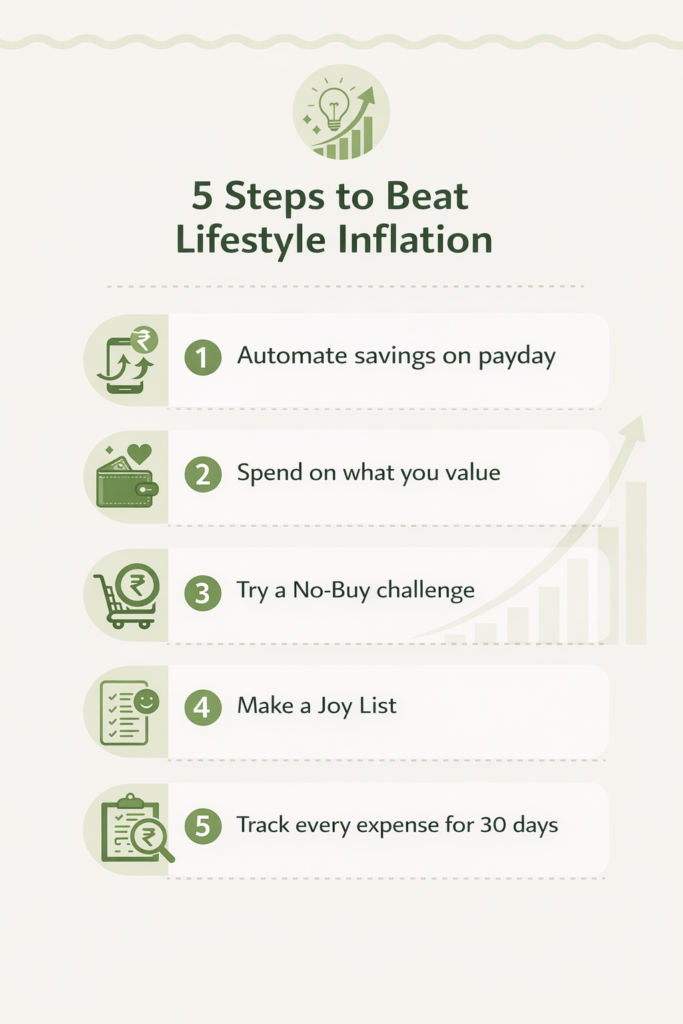
| 📋 What You Will Learn Step 1: Automate your savings before you spend Step 2: Spend on what actually matters to you Step 3: Try the No-Buy Challenge Step 4: Make a Joy List and spend on it guilt-free Step 5: Track every expense for 30 days |
Step 1 of 5
Automate Your Savings Before You Spend
The easiest way to save more? Never see the money in the first place.
When you get a raise or a bonus, move part of it to savings right away. Set up an automatic transfer. Do it the day you get paid. You will not miss what you never see.
| 💡 Simple Example You get a raise of ₹50,000 per month. Set up an auto-transfer of ₹35,000 to your investment account on payday. You never see it. You never spend it. Your savings grow without any effort. |
Use the 50/30/20 Rule
Put 50% of your income toward needs.
Spend 30% on wants.
Save 20%.
When you get a raise, put 50 to 75% of that extra money into savings. Enjoy a small reward. But make sure most of the new money goes toward your future.
| 🙋 Real Story: Ramesh is a 28-year-old software engineer in Bangalore. He got a 20% raise. He did not upgrade his flat or buy a new car. He increased his monthly SIP by 15% right away. In two years, his investments grew by nearly ₹12 lakhs. All from money he never touched. |
Step 2 of 5
Spend on What Actually Matters to You
Most people overspend on things they do not even care about.
Ads tell you what to buy. Friends influence you. Social media shows you what others have. Before you know it, you are spending on things that bring you no real joy.
Here is what to do instead. Take one hour. Write down what you truly value. Think about health, family, travel, or learning. Then look at where your money goes each month. Does it match your values?
The Two-Column Test
Make a simple list on paper.
- Column A — Good Spending: Gym, weekend trips, online courses
- Column B — Wasted Spending: Branded coffee, unused subscriptions, sale clothes you never wear
Cut Column B. Move that money to Column A. Now every rupee you spend has a purpose.
Step 3 of 5
Try the No-Buy Challenge
The No-Buy Challenge is simple. For a fixed period, you buy only what you need.
That means rent, food, utilities, and transport. No new clothes. No takeout. No impulse buys. All the money you save goes toward debt or your emergency fund.
| 📊 How Big Is This Trend? No-Buy 2026 groups on social media have over 70,000 members. Videos on YouTube and TikTok have millions of views. It is one of the biggest money trends of 2026. |
You do not have to do a full year. Start with one week or one month.
The goal is not to suffer. The goal is to stop spending on autopilot.
| 🙋 Real Story: Priya is a marketing professional in Mumbai. She tried No-Buy January. She stopped ordering food online. She skipped clothes shopping. She deleted promotional emails. By the end of the month, she had saved ₹18,000. That was enough to fund her Goa trip. She realised most of her spending was just a habit, not a choice. |
Step 4 of 5
Make a Joy List and Spend on It Guilt-Free
Cutting all fun spending does not work. You feel miserable and give up.
Instead, figure out what actually makes you happy. Make a short list. Budget for those things. Protect them. Then cut everything else.
How to Make Your Joy List
- Write down 10 things that make you truly happy
- Write the cost of each one next to it
- Circle the top 3 that give you the most happiness per rupee
- Budget for those 3 every month
| 🙋 Real Story: Ankit liked reading and hiking. Shopping did not make him happy. He made a joy list: ₹1,000 for books, ₹2,000 for treks, ₹500 for coffee with friends. He cut his ₹8,000 monthly shopping habit completely. He felt richer, not poorer. |
When you spend on purpose, money stops being a source of guilt. It becomes a tool for joy.
Step 5 of 5
Track Every Expense for 30 Days
You cannot fix what you do not measure.
For 30 days, write down every single thing you spend money on. Every chai. Every app subscription. Every impulse buy.
Use a phone app, a Google Sheet, or a simple notebook. Set a reminder every evening to review your spending. Do not judge yourself. Just collect the data.
| 🙋 Real Story: Neha is a 32-year-old teacher. She tracked her spending for 30 days. She found she was spending ₹12,000 a month on things she barely remembered buying. Unused app subscriptions. Late-night purchases. Snacks out of boredom. She cancelled 6 subscriptions and made a rule: wait 48 hours before any purchase over ₹1,000. In three months, she paid off her credit card and started an emergency fund. |
After 30 days, you will see exactly where your money goes. Cut what does not matter. Keep what does.
Conclusion
The Bottom Line
Lifestyle inflation is a real problem. But it is one you can beat.
People all over the world are changing the way they spend. No-buy challenges, loud budgeting, values-based spending. Being smart with money is no longer boring. It is something people are proud of.
| Lifestyle inflation happens when your spending grows with your income. Wants become needs with every raise. And the biggest casualty is your long-term wealth. |
The most financially secure people in 2026 will not be the highest earners. They will be the most aware ones.
They know where their money goes. They spend on purpose. They save before they see it.
Automate your savings. Spend on what you value. Track your expenses. Cut the rest.
Your future self — the one with zero debt, a solid emergency fund, and a growing portfolio — will thank you.