
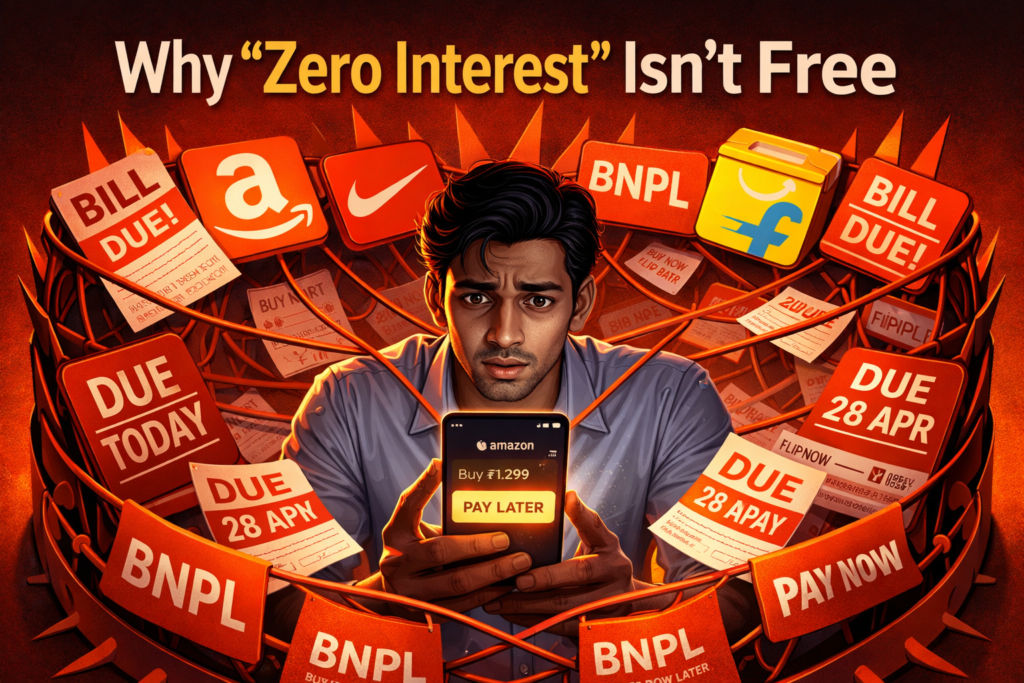
A real story about the Buy Now Pay Later trap in India — and the 5 hidden dangers every young Indian must understand before clicking “Pay Later” again
⚠️ Real Story: The name has been changed to protect privacy. If you have a similar financial mistake story, share it at mistakeindia.com/submit-your-financial-mistake
The BNPL trap in India is not dramatic. It does not arrive with a warning letter or a loud alarm. It arrives as a tiny, friendly button at the checkout page of your favourite shopping app. It says “Pay Later” or “3 easy installments” or “Zero interest.” And because it looks so simple, so harmless, so convenient — you click it without thinking twice.
That is exactly what Priya did. She is a 24-year-old content writer from Bangalore, earning a decent salary, living independently, and managing her own finances. She was not careless with money. She was not reckless. She simply did not understand how the BNPL trap in India actually works — until it was too late.
In 12 months, Priya accumulated ₹78,000 in Buy Now Pay Later debt. Her CIBIL score dropped by over 120 points. And when she tried to apply for a home loan, the bank rejected her application. This is her real story.
How It Started: One Small Purchase That Changed Everything
Priya’s first BNPL purchase was small. A skincare product on Nykaa worth ₹1,800. She had the money. But LazyPay was offering three installments of ₹600 — spread over three months. It felt smart. It felt like she was managing her cash flow better.
“I thought it was like a credit card, but easier. No application process, no credit check, no waiting. Just click and done. I had no idea I was walking into a BNPL trap.”
Over the next year, Priya used BNPL across six different platforms. The amounts were never large. That is the trick. Each individual purchase felt affordable. But the total told a very different story.
Here is what she bought using BNPL in 12 months:
- Myntra (clothing, 4 purchases) — ₹16,400
- Amazon Pay Later (gadgets and accessories) — ₹22,000
- Swiggy and Zomato (food delivery, over 40 orders) — ₹8,600
- MakeMyTrip (Goa trip booking) — ₹19,000
- Random impulse purchases across apps — ₹12,000
Total: ₹78,000 in Buy Now Pay Later debt. Ten different due dates. Six different apps. And completely no single clear picture of how much she owed in total.
When the due dates all landed in the same week, Priya finally saw the full number. That was the moment she understood she had fallen into the BNPL trap in India that millions of young people are silently walking into every single day.
The 5 Hidden Dangers Inside Every BNPL Trap in India
Most people understand BNPL as a payment method. Very few understand it as a financial trap. Here are the five dangers that BNPL companies do not put on their homepage — but that every Indian using Pay Later apps must know.
Danger 1: “Zero Interest” Is Only True If You Never Miss a Payment
Every BNPL app in India advertises zero interest. This is technically true — but only under one very strict condition: you pay every installment on exactly the right date. Miss even one payment by a single day, and late fees plus penalty interest apply immediately.
The penalty rates are steep. Many Buy Now Pay Later platforms in India charge between 2 and 3 percent per month as a late fee — which translates to 24 to 36 percent annually. That is higher than the interest rate on most credit cards in India.
Priya missed two payments across different apps in the same month, simply because she lost track of which due date belonged to which platform. The combined late fees added ₹4,200 to her total debt in a single month.
📌 Key Lesson: “Zero interest” in BNPL means zero interest if everything goes perfectly. Real life is rarely perfect. Before using any Buy Now Pay Later app, read the late payment terms carefully. The penalty rate is what matters, not the headline rate.
Danger 2: The BNPL Trap in India Damages Your CIBIL Score Silently
This is the danger that shocks most people. Most Indians assume BNPL is informal — like borrowing from a friend. It is not. In 2026, the majority of BNPL lenders in India report payment history to CIBIL and other credit bureaus.
Every missed or late Buy Now Pay Later payment goes directly onto your credit report. Your CIBIL score starts falling. And because these are small purchases — ₹1,000 here, ₹3,000 there — most people do not even realize the damage is happening.
Priya discovered this the hard way. Her CIBIL score was 762 before she started using BNPL heavily. After 12 months of scattered late payments, it had fallen to 641. She did not find out until a bank rejected her home loan application and asked her to check her credit report.
📊 Data Point: A 120-point CIBIL score drop can push you from the “good credit” bracket to the “risk” bracket. Banks use this number for home loans, car loans, personal loans, and even job background checks in some industries.
📌 Key Lesson: Always check your CIBIL score at cibil.com. It is free once a year. If you are using multiple BNPL apps, check it every 3 months. One missed ₹500 payment on a food delivery app can silently start damaging your financial future.
Danger 3: Multiple Apps Create a Debt Maze You Cannot Navigate
One BNPL app is manageable. Two is confusing. Six is a financial disaster waiting to happen. This is exactly how the BNPL trap in India scales — gradually, across multiple platforms, until you genuinely lose track of what you owe and to whom.
India’s Buy Now Pay Later ecosystem includes Amazon Pay Later, Flipkart Pay Later, LazyPay, Simpl, PhonePe Pay Later, and many others. Each has a different due date, a different credit limit, a different penalty structure, and a different customer support system. Managing all of them simultaneously requires more financial discipline than most people have — especially when the purchases feel small.
“I had six apps and ten due dates in a single month. I was paying one to avoid a late fee and forgetting another. It felt like I was always behind, always catching up.”
📌 Key Lesson: Use only one BNPL app at any time. If you must use a second, close the first. Multiple open Buy Now Pay Later accounts multiply your debt exposure and make tracking almost impossible.
Danger 4: BNPL Is Scientifically Designed to Make You Spend More
This is not a coincidence. It is a deliberate product design choice. BNPL platforms are built around a well-documented psychological principle called the “pain of paying.” When you pay cash or use a debit card, your brain registers the loss immediately. It acts as a natural brake on overspending.
When you use Buy Now Pay Later, that pain is delayed. You get the product now, but the financial reality arrives weeks later. Research on consumer psychology consistently shows that BNPL users spend 20 to 40 percent more than cash buyers on the same type of purchase.
Priya confirmed this herself. She would not have spent ₹19,000 on a Goa trip if she had to pay it all at once from her account. Broken into four installments of ₹4,750, it felt like a very different, much more manageable decision. The total amount was the same. But the psychological weight was not.
📊 Research finding: Merchants who add BNPL options at checkout see average order values rise by 30 to 45 percent. That money comes from customers who would not have spent it otherwise.
📌 Key Lesson: Before any BNPL purchase, ask yourself one question: “Can I pay this full amount from my account right now?” If the answer is no, you cannot afford it. BNPL is not a budgeting tool. It is a spending accelerator.
Danger 5: Hidden Processing Fees That You Never Read
The checkout screen moves fast. The “Pay Later” option appears. You tap it. You move on. Almost nobody reads the fine print. And buried inside that fine print are processing fees, platform fees, and convenience charges that quietly add to every transaction.
Different BNPL providers in India structure these fees differently. Some charge a flat fee per transaction. Others include it as a markup on the product price. Some charge nothing upfront but apply fees if you request any changes to your repayment schedule. Individually they are small. Across 30 or 40 transactions in a year, they become a significant hidden cost.
This is a core part of how the BNPL trap in India works. The advertised product is always free, always convenient, always zero interest. The actual cost is buried in the details, spread across many small transactions, and never shown to you as a single clear total.
📌 Key Lesson: Before using any Buy Now Pay Later service, search for “processing fee,” “platform fee,” and “late payment penalty” in its Terms and Conditions. If a company does not show these clearly, that is a warning sign.
How Priya Escaped the BNPL Trap and Cleared ₹78,000 in 7 Months
Once Priya understood the full picture, she made a plan. It was not complicated, but it required real discipline.
- Deleted all six BNPL apps from her phone immediately
- Created a single spreadsheet listing every outstanding amount, platform, due date, and interest rate
- Used the avalanche method — paid the highest-penalty debt first, then moved down the list
- Set a strict rule: zero online shopping for three months except groceries and essentials
- Set up a monthly CIBIL score alert to track her recovery progress
Result: In 7 months, she cleared the entire ₹78,000. Her CIBIL score began recovering after month 4. By month 9, it was back above 700. She has not used a BNPL app since.
“I now have one simple rule. If I cannot pay for something today, I cannot afford it. BNPL made me feel richer than I was. That feeling cost me seven months of my salary.”
The Scale of the BNPL Trap in India: Numbers That Should Worry You
Priya’s story is not an edge case. It is becoming one of the most common financial mistakes among young Indians in 2026. Here is what the data shows:
📊 India’s BNPL market is expected to reach $30.45 billion in 2026 — growing at 22.5% annually.
📊 Generation Z holds a 39% share of India’s total BNPL usage — the highest of any age group.
📊 The target age group for BNPL in India is 25 to 35 — exactly first-time earners and first-time credit users.
📊 Merchants that add BNPL at checkout see cart abandonment fall by 51% and average order value rise by 30%.
📊 RBI’s Digital Lending Directions 2025 have tightened rules — but millions of Indians are already in BNPL debt cycles.
The BNPL trap in India is not a future risk. It is a present reality that is quietly affecting the credit scores, savings habits, and financial futures of millions of young Indians who simply wanted a convenient way to shop.
5 Rules That Will Protect You From the BNPL Trap in India
BNPL is not always bad. Used correctly, it can be a useful short-term tool. These five rules will keep you safe:
- Only use BNPL for something you can pay in full right now from your bank account. BNPL should be a payment method, not a credit line.
- Use only one BNPL platform at any time. Close any account you are not actively using.
- Set a phone reminder two days before every BNPL due date. Late fees are avoidable — but only if you are organised.
- Never use Buy Now Pay Later for food delivery, entertainment, or clothing. These are impulse categories where overspending is almost guaranteed.
- Check your CIBIL score every three months. If it starts falling and you cannot identify why, check your BNPL payment history first.
FAQ: BNPL Trap India — Your Questions Answered
Q: What exactly is the BNPL trap in India and why is it growing so fast?
The BNPL trap in India refers to the pattern where consumers use Buy Now Pay Later services for small, frequent purchases across multiple platforms, lose track of total debt, miss payments due to confusion, and find their credit scores damaged and finances strained. It is growing rapidly because BNPL is embedded directly inside the most popular shopping, food delivery, and travel apps that young Indians use daily. The convenience is real. The risks are invisible until it is too late.
Q: Does BNPL actually affect your CIBIL score in India?
Yes, absolutely. As of 2026, most BNPL lenders in India report to CIBIL and other credit bureaus. A missed or late payment on even a small Buy Now Pay Later transaction will appear on your credit report and lower your CIBIL score. This directly affects your eligibility for home loans, car loans, personal loans, and premium credit cards. Many people discover this damage only when they apply for a major loan and get rejected.
Q: Is BNPL better or worse than a credit card in India?
For most Indians, a credit card is safer and more transparent than BNPL if used responsibly. A credit card gives you one monthly bill with everything in one place, consumer protection under RBI regulations, rewards and cashback, and a clearly disclosed interest rate. BNPL spreads your debt across multiple apps with different rules, less consumer protection, and hidden fees. The BNPL trap in India is partly so effective because it lacks the unified visibility that a single credit card statement provides.
Q: How do I get out of BNPL debt in India?
Start by listing every BNPL platform and the exact amount you owe on each. Stop making any new BNPL purchases immediately. Pay off the account with the highest penalty rate first using the avalanche method. If total debt is large, consider taking a single low-interest personal loan to consolidate all BNPL dues into one manageable monthly payment. Most importantly, delete the apps after clearing each account so you are not tempted to start the cycle again.
Q: Which BNPL apps are safest to use in India?
No BNPL app is inherently safe or unsafe — the risk comes from how you use it, not which brand it is. Choose platforms that clearly disclose all fees upfront, are partnered with RBI-registered NBFCs, allow you to see your total outstanding balance in one screen, and have responsive customer support. The single most important factor is your own discipline. The safest BNPL use is one purchase, one platform, paid in full on time.
Conclusion: The Button Says “Pay Later.” Your Future Pays Now.
The BNPL trap in India works because it is designed to be invisible. Each individual purchase is small. Each individual payment is manageable. But the system accumulates debt faster than most people can track, damages credit scores before most people notice, and creates financial anxiety that is completely avoidable.
Priya lost seven months of savings to a trap that started with a ₹1,800 skincare purchase. She recovered — but it took discipline, sacrifice, and a painful education in how Buy Now Pay Later actually works.
You do not have to learn this the hard way. Read the story. Understand the trap. And next time that “Pay Later” button appears at checkout, ask yourself one question: can I pay this right now? If the answer is yes — pay it now. If the answer is no — do not buy it at all.
📢 Have You Fallen Into the BNPL Trap in India?
Your real story can protect thousands of other Indians from making the same mistake.